
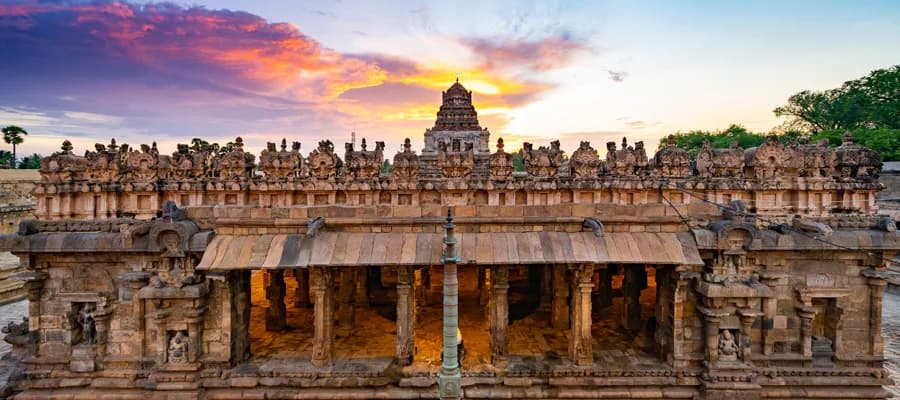
About Airavatesvara Temple
The Airavatesvara Temple, situated in the historic town of Darasuram close to Kumbakonam, is one of the best surviving instances of Chola temple architecture in Tamil Nadu. It was constructed during the time of Chola king Rajaraja II in the 12th century and is devoted to Lord Shiva, being well known for its beautiful stone carvings, elaborate sculptures and unique architectural style. Even though it is much smaller than the massive Brihadisvara Temple at Thanjavur, the Airavatesvara Temple is especially praised for the refinement and intricacy of its craftsmanship. The temple's sculptural details, its ornate pillars and the richly decorated mandapas show the exceptional skill of the Chola artisans. It is included in the Great Living Chola Temples, which also comprise the Brihadeeswara Temple at Thanjavur and the Brihadisvara Temple in Gangaikondacholapuram. This group was listed on the UNESCO World Heritage List in 2004 as a recognition of its outstanding contribution to South Indian architecture, sculpture and cultural heritage.
Airavatesvara Temple and the Great Living Chola Temples
Airavatesvara Temple in Darasuram is one of the three monuments which, together, make up the Great Living Chola Temples UNESCO World Heritage site.
The other two are:
• Brihadeeswara Temple at Thanjavur
• Brihadisvara Temple at Gangaikondacholapuram
These monuments show the evolution of Chola architecture and artistic practices at various stages of the empire. UNESCO has acknowledged the three temples for their exceptional contributions to Dravidian architecture, sculpture, painting, bronze casting and cultural expression. Different from other monuments which remain only as archaeological remains, the Great Living Chola Temples still hold religious importance. At these living temples, traditional forms of worship and rituals are carried out, thus keeping a significant link between the ancient monuments and present-day Tamil religious culture.
Explore UNESCO World Heritage Sites In Tamil Nadu
History of Airavatesvara Temple
Airavatesvara Temple in Darasuram was built while Rajaraja II was king of the Chola kingdom in the 12th century. This time saw the ongoing advancement of Chola art, architecture, sculpture, literature and religious practices. Darasuram had a historical connection with Palaiyarai, a significant Chola centre which had functioned as a residence and a political strongpoint. The temple's construction shows the later stage in the development of Chola architecture, a stage in which temple builders tended to include more elaborate sculptural decoration while at the same time keeping the basic principles of Dravidian temple architecture. The Airavatesvara Temple is thus important not only as a place where people can worship but also as a record of the artistic accomplishments of the later Chola period. The temple complex has kept most of its original features, which makes it a valuable monument for studying the evolution of Chola art and architecture.
The Legend behind the Name Airavatesvara temple, Darasuram
The name Airavatesvara is connected with Airavata, the holy white elephant which is the mount of Lord Indra. In accordance with Hindu tradition, Airavata paid worship to Lord Shiva at this holy place. It is believed that the elephant had been subjected to a curse as a result of which its usual white colour was altered. After having worshipped Shiva and obtained his blessing, Airavata was once again restored to its original state. Since Airavata is said to have worshipped Shiva, the principal deity acquired the name Airavatesvara, which means the Lord worshipped by Airavata. This myth therefore gives the temple an extra element of importance by connecting its religious identity with the various legends linked to Shiva temples in the Kumbakonam area.
Special Features of Airavatesvara Temple
The Airavatesvara Temple at Darasuram is famous for its outstanding Chola architecture and the elaborate stone carving work. A particularly notable feature of the temple is the Rajagambhiran Tirumandapam, which is shaped like a stone chariot and has beautifully carved wheels as well as ornate pillars. The temple is also known for its finely detailed sculptures, the small carvings, the mythological figures, the dancers, the musicians, and the various representations connected with the 63 Nayanmars. Its elegant vimana, the richly decorated pillars and the sculptural panels all illustrate the artistic achievement of the Chola period. It is traditionally linked with musical stone steps, which contributes to the temple's architectural appeal. As one of the Great Living Chola Temples, together with the Brihadisvara Temples at Thanjavur and Gangaikondacholapuram, the Airavatesvara Temple has exceptional cultural and architectural value and is acknowledged as a UNESCO World Heritage Site. The temple is still a living temple and provides visitors with a rare chance to experience the artistic, religious and architectural legacy of the Chola dynasty.
Architectural Significance of Airavatesvara Temple
The Airavatesvara Temple in Darasuram is one of the best examples of Chola architecture and illustrates the outstanding engineering ability, artistic creativity and sculptural skill of the 12th century. Constructed while Rajaraja II was king, the temple reflects an advanced stage of Dravidian temple architecture in which structural design, religious symbolism and the detailed stonework were combined with great precision.
A Fine Example of Dravidian Architecture
The temple adheres to the traditional principles of Dravidian temple architecture, the sanctum, vimana, mandapas and the subsidiary shrines being carefully arranged throughout the temple complex. Yet, unlike a number of the huge Chola temples, Airavatesvara is especially praised for its refined proportions, elaborate ornamentation and exceptional sculptural detail.
The Elegant Vimana
The vimana, which rises above the sanctum, is a significant element of the temple's architecture. Even though it is much smaller than the huge vimana of the Brihadeeswara Temple in Thanjavur the careful proportions of its structure and the detailed decoration show how advanced later Chola architecture was.
The Chariot-Shaped Mandapa
A highly notable characteristic of the Airavatesvara Temple is the Rajagambhiran Tirumandapam, which is shaped like a stone chariot. The mandapa has beautifully carved stone wheels and detailed architectural work that creates the effect of a chariot standing permanently in front of the temple; its ornately decorated pillars are adorned with intricate sculptures and decorative designs, making it one of the most visually impressive sections of the complex. The fact that the chariot design shows the ingenuity of the Chola architects, who have turned ordinary architectural elements into symbolic and artistic ones.
Miniature Sculptures and Narrative Panels
A further important feature of the temple is the group of small sculptures and narrative panels it contains. Even though they are small, these carvings show an amazing degree of accuracy. The scenes from Hindu mythology and the Shaivite traditions are depicted using carefully arranged figures and ornamental panels, which turns the temple into a visual expression of religious tales and cultural traditions.
Representations of the 63 Nayanmars
The temple includes sculptural depictions linked to the 63 Nayanmars, the respected Shaivite saints of the Tamil tradition. The sculptures show the significant influence of Shaivism during the Chola period and illustrate the way religious traditions were integrated into temple architecture; furthermore, the representations of the Nayanmars also link the monument with Tamil devotional literature and the wider Bhakti movement.
Deivanayaki Amman Shrine
The temple complex also has a separate shrine dedicated to the goddess, the Deivanayaki Amman. The fact that there is a particular Amman shrine shows the way in which the design of South Indian temple complexes has developed, since shrines devoted to the divine consort have increasingly become an important element in temple planning. The architecture of the shrine and its position help to contribute to the overall arrangement of the sacred complex.
Refinement Rather Than Monumental Scale
The Airavatesvara Temple is so unique because its architectural brilliance is not based merely on its great size. Although smaller in scale than the massive Brihadisvara Temple at Thanjavur, the Darasuram temple is more compact and yet its precision, proportion, ornamentation and richness in sculpture make it no less remarkable. It shows how Chola architects were able to achieve a sense of grandeur by focusing on detail, symmetry, proportion and craftsmanship.
Part of the Great Living Chola Temples
The Airavatesvara Temple is included among the Great Living Chola Temples, which also comprise the Brihadeeswara Temple at Thanjavur and the Brihadisvara Temple at Gangaikondacholapuram. These three monuments illustrate key stages in the evolution of Chola temple architecture and show the remarkable accomplishments of the Chola builders, sculptors and artisans. The group was designated as a UNESCO World Heritage site, underscoring its exceptional cultural and architectural value.
Airavatesvara Temple for Heritage Travellers
For those travelling to study the cultural heritage of Tamil Nadu, Darasuram offers the chance to encounter a more peaceful and personal aspect of Chola architecture. The temple is particularly worthwhile for tourists who have an interest in history, architecture, sculpture, photography and cultural tourism. Since it is on a relatively small scale, visitors can take the time to look at the individual carvings and architectural details instead of just viewing the monument from afar. The temple may also be incorporated into a wider heritage tour of Kumbakonam, together with some of the other historic temples in the area. Because it is close to Kumbakonam, Darasuram is a convenient place for travellers who are visiting the ancient temple towns of the Cauvery Delta.
Best Time to Visit Airavatesvara Temple
From October through to March the cooler months are usually pleasant for touring the historic temples in the Kumbakonam area. Those who want to study the sculptures in more detail might choose to visit in the morning or in the later part of the afternoon when the weather is more agreeable. Since Airavatesvara is a living temple, tourists should also take into account the religious atmosphere and observe the rules concerning dress, photography and entry to various sections.
How to Reach Airavatesvara Temple at Darasuram
By Air : The nearest major airport to the Airavatesvara Temple at Darasuram is Tiruchirappalli International Airport, which is about 90 km from Darasuram. This airport provides frequent services to both domestic and international destinations. Once at the airport, guests can get to Darasuram by taxi or other forms of road transport. Travellers may also consider Chennai International Airport, which is about 280 km from Darasuram; the airport provides extensive links both within India and with foreign destinations and could therefore be regarded as a choice for visitors who are planning a more extensive tour of Tamil Nadu.
By Train : The closest major railway junction is Kumbakonam Railway Station, which is about 5 km from the Airavatesvara Temple. The town of Kumbakonam has good rail connections with Chennai, Tiruchirappalli, Thanjavur and other significant cities in Tamil Nadu. Travellers departing from Kumbakonam Railway Station have the option of taking a taxi, an auto-rickshaw or a local bus in order to get to Darasuram.
By Road : Darasuram has good road connections with Kumbakonam, Thanjavur and some of the other major towns in the Cauvery Delta area. People coming from Thanjavur can take the NH 36 route to reach Kumbakonam, as this road links several towns in the area. After arriving in Kumbakonam, Darasuram is just a short drive along a local road. Those travelling from Chennai usually take NH 32 and then NH 36 to get to the Kumbakonam area, while visitors starting from Tiruchirappalli can reach Kumbakonam by using NH 81 and the connecting roads.
Airavatesvara Temple Photos
FAQs
Frequently Asked Questions
1. For what is the Airavatesvara Temple known?
2. What is the location of the Airavatesvara Temple?
3. Who constructed the Airavatesvara Temple at Darasuram?
4.What are the major attractions of the Airavatesvara Temple?
5. Can you tell me the opening hours of the Airavatesvara Temple?
6. Is the Airavatesvara Temple worth a visit?
More Tamil Nadu Temples
Explore Tours by Themes
Our Tamil Nadu tour packages include temple tours, cultural experiences, hill station trips, nature & wildlife adventures, honeymoon packages, and family tours. Every package is designed to provide comfort, convenience, and memorable experiences across the state.


